- This event has passed.
Deep-sea Ecosystems Functioning and Monitoring
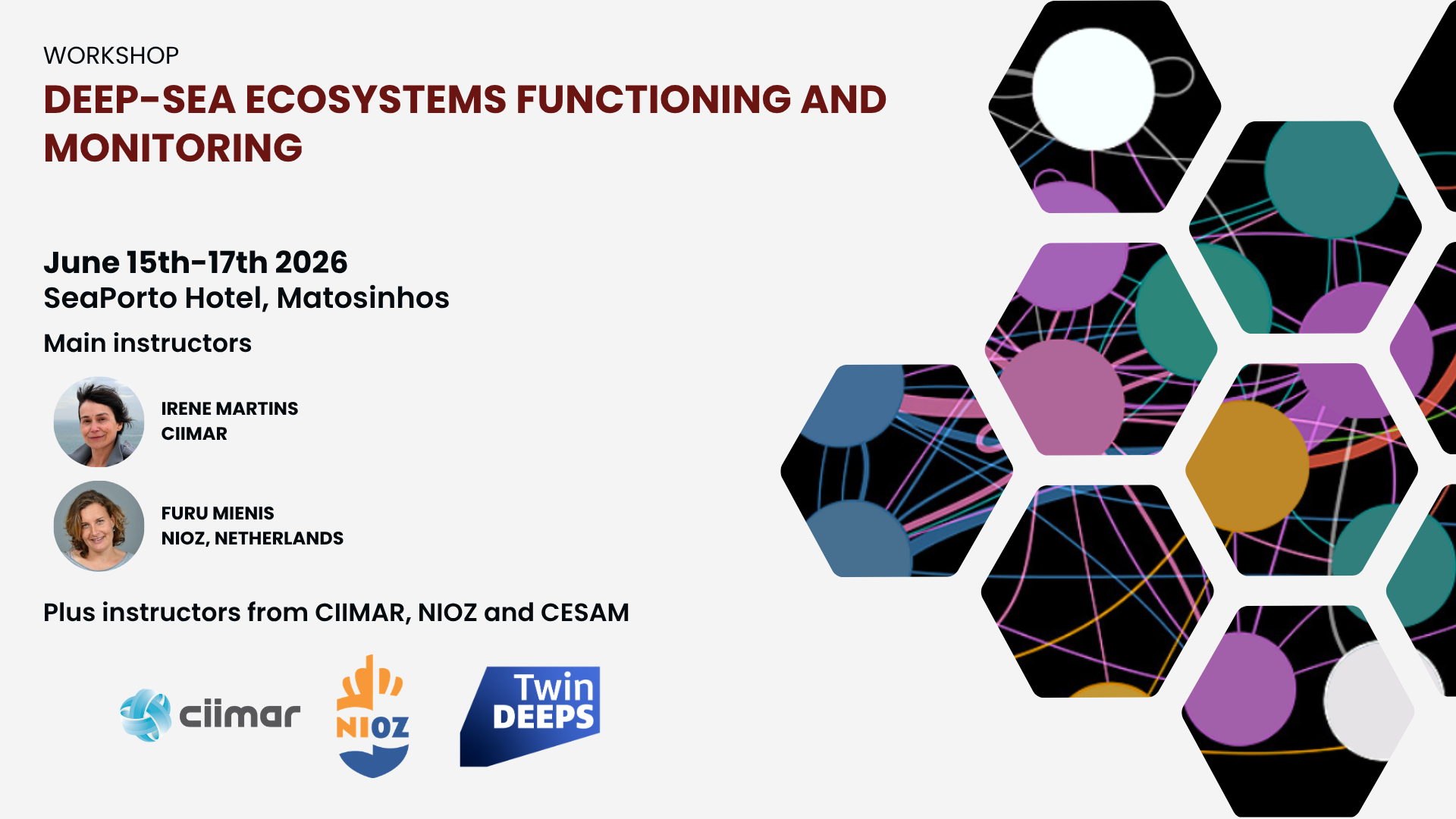
It will be a three-day event taking place on 15-17 June 2026.
DESCRIPTION:
- Target audience: MSc/PhD students to established researchers
- Requirements: All participants will have to bring their own laptops for the practical exercises
- Location: SeaPorto Hotel, Matosinhos
- Registration is free for all participants
Registrations are open until 08 June 2026. If you don’t receive a confirmation e-mail upon your registration, please contact twindeeps@ciimar.up.pt.
NOTE:
A maximum of 20 participants will be selected for the workshop, considering their motivation and the potential impact of the workshop in their careers.
Workshop Instructors (in alphabetical order):
Ana Hilário is a deep-sea ecologist at Centre for Environmental and Marine Studies of the University of Aveiro (Portugal). Ana holds a BSc in Aquatic Sciences from University of Porto (2001), and PhD in Ocean and Earth Science from Southampton University (2005). Her research focuses on 3 topics in deep-sea biology: 1) biodiversity and biogeography of chemosynthetic ecosystems, 2) reproductive ecology of invertebrates and 3) population connectivity and its implications for conservation and biogeography. Ana has contributed to the policy process by authoring and reviewing the UN Assessment of the State of the Marine Environment and has worked with Portuguese Ministry of the Sea in the design of a national network of MPAs. Currently she co-leads the working groups “Population Connectivity” in INDEEP (International network for scientific investigation of deep-sea ecosystems) and “Decade for Deep-Ocean Science” in DOSI (Deep-Ocean Stewardship Initiative). Ana has participated in 23 oceanographic cruises dedicated to the study of deep-sea ecosystems and has a vast experience in seafloor sampling and in situ experimentation.
Ana Sofia Lavrador holds a PhD in Molecular and Environmental Biology from the University of Minho and is currently a junior researcher at CIIMAR, working in the field of deep-sea biodiversity and conservation. Her research focuses on the use of environmental DNA (eDNA), DNA metabarcoding, and bioinformatic workflows to support biodiversity monitoring and marine conservation. During her PhD, she investigated the application of DNA metabarcoding for the early detection and monitoring of marine non-indigenous species in Portuguese coastal systems. She is now involved in the BioProtect project, where she works on eDNA-based approaches for detecting and monitoring deep-sea Vulnerable Marine Ecosystem indicator taxa, particularly corals and sponges. Her current work integrates field sampling strategies, molecular methods, reference database assessment, and reproducible bioinformatics to improve the use of eDNA as a tool for deep-sea ecosystem monitoring and management.
Emil De Borger obtained a masters degree in Marine Biology – Conservation Biology and Ecosystem Management at the Vrije Universiteit Brussel, Antwerp University, and Ghent University. He completed his PhD at Ghent University and the Royal Netherlands Institute of Sea Research (NIOZ, Yerseke), with a dissertation entitled “Human and natural impacts on North Sea sediment biogeochemistry”. Afterwards he was a postdoc at the NIOZ, and later at Ghent University, studying energy flows surrounding offshore wind farms, and benthic pelagic coupling in polar ecosystems. He is currently a tenure track scientist at the NIOZ, to develop research on seafloor biogeochemistry in diverse settings.
Dr. Furu Mienis works in the department of Ocean Systems at the NIOZ Royal Netherlands Institute for Sea Research. Her area of specialization is sedimentology and environmental analysis and her research focuses on understanding processes occurring at the sediment-water interface following a multidisciplinary process-based approach with the main goal to ultimately define their influence on sediment transport and deep-sea ecological hotspots. In parallel to her more fundamental research, Furu Mienis works on the technical development of deep-sea landers, which resulted in several new observational and autonomous sampling tools.
Helena Vieira, University of Aveiro
Irene Martins holds a PhD in Ecology and specialises in Coastal Ecology and Marine Ecosystem Modelling. She leads the Marine Ecosystem Modelling team at CIIMAR (University of Porto, Portugal), where she coordinates research on the development and application of numerical models to assess the impacts of multiple stressors—such as climate change, pollutants, plastics, and invasive species—on coastal and marine ecosystems. Her team focuses on food web models to support the analysis of the structure and functioning of marine social-ecological systems. She teaches and organises courses in ecological modelling, programming languages, and complex system dynamics. She is a member of the ICES expert group (WGENGAGE), which aims at bridging the gap between scientists and stakeholders.
Jacinto Cunha is an interdisciplinary ecologist working at the interface of ecological theory, ecosystem services science, and geospatial modelling in marine and coastal socio-ecological systems. His research focuses on understanding how ecosystem structure and functioning sustain ecosystem services, and how climate change and human pressures affect their supply and resilience. He specialises in developing spatially explicit, data-driven approaches and modelling frameworks to support evidence-based ecosystem management and planning, and sustainable coastal and marine governance.
Joana Xavier is an Assistant Researcher and leader of the Deep-Sea Biodiversity and Conservation Research Team (DEEP) at CIIMAR – University of Porto (Portugal), and an invited Associate Professor in Deep-Sea Biology at the Department of Biological Sciences of the University of Bergen (Norway). Her research focuses on the understanding of basin-scale diversity, biogeographic, and connectivity patterns of deep-sea vulnerable marine species and habitats (e.g. sponge grounds, cold-water coral gardens), using a combination of disciplines (taxonomy, systematics, ecology and genetics), and exploration and sampling tools (remotely operated vehicles, towed cameras). I also strive to advance the science-policy-society interface, working with local communities to integrate their knowledge and perceptions on marine biodiversity into decision-making; as well as developing tools and transferring knowledge to support the implementation of agreements and instruments for sustainable management, conservation, and restoration of deep-sea habitats.
Marcel van der Meer studies the salt content, salinity, in seas and oceans in the past to better understand future climate developments. Salt can help us to reconstruct ocean circulations in the past. The large global ocean circulation distributes heat across the earth. If the ice caps melt as a result of global warming causing the uppermost water layer of the North Atlantic Ocean to become less saline, then that could slow the warm Gulf Stream. This could potentially lead to colder conditions in Western Europe. I conduct my work primarily by measuring deuterium, a rare form of hydrogen, in molecular fossils of algae.
Sandra Ramos is a PhD researcher and team leader of the Fish Ecology and Sustainability Team at CIIMAR-UP. Her primary research area is marine ecology, impact of. anthropogenic pressures on ecosystems and on their capacity to deliver services and societal benefits. She has experience in local assessments of provisioning, regulation and maintenance, and cultural ecosystem services provided by marine ecosystems. She applies multidisciplinary and participatory approaches, integrating stakeholder knowledge into scientific research to enhance environmental management and decision-making. She is also a member of the ICES expert group (WGRMES), where she collaborates with various international experts on Ecosystem services.